
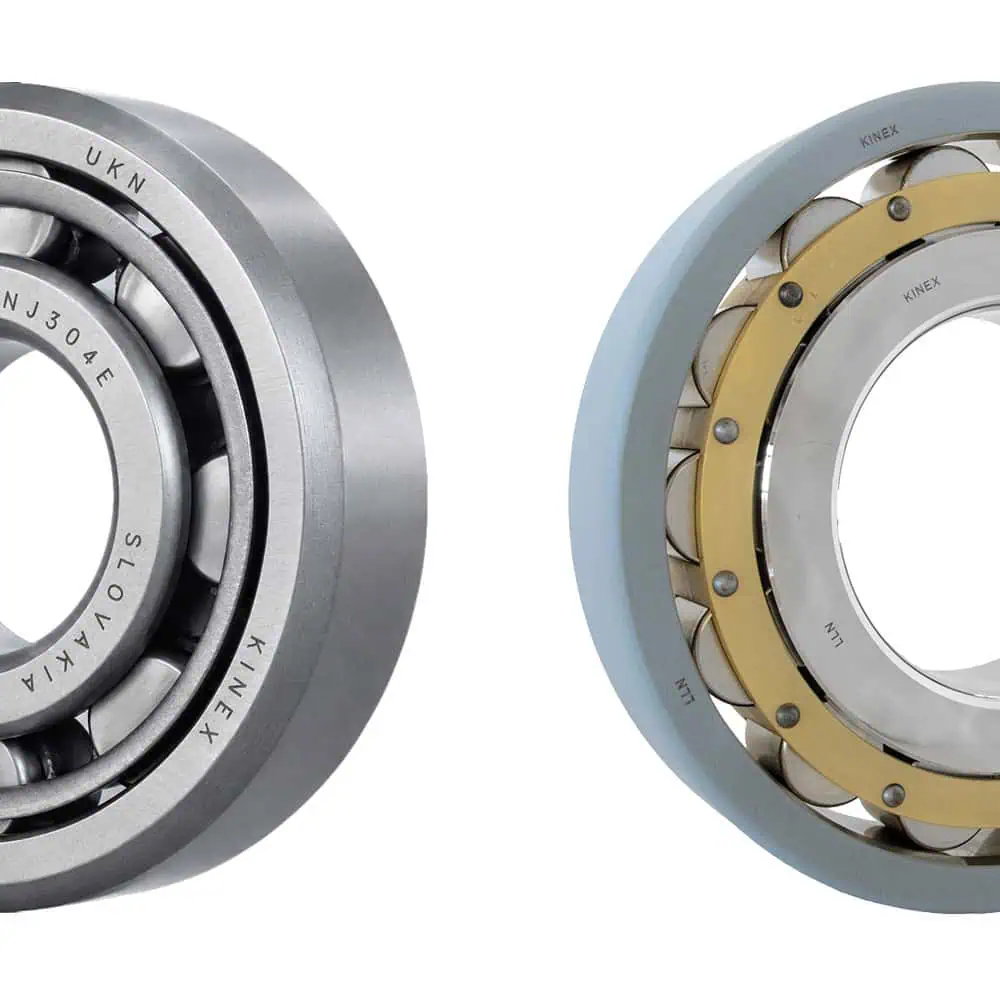
Standard vs Special Bearings: Introduction
Bearings are essential components of rotating machinery. They support loads while enabling controlled and efficient movement between machine components. Standard bearings are suitable for a wide range of industrial applications, but some machines require bearing solutions adapted to specific operating conditions.
The main difference between standard and special bearings lies in their use in specialized equipment and applications, where different dimensions, materials, tolerances, clearances, cage designs, seals, lubrication systems, and other application-specific features may be required.
Standard bearings are manufactured according to established dimensional and technical specifications, whereas special bearings are designed or modified to meet requirements that cannot be fully addressed by standard bearings.
What Are Standard Bearings?
Standard bearings are manufactured according to established industrial and international specifications. Their dimensions, tolerances, load ratings, and other characteristics are standardized, making them widely interchangeable and readily available.
Key Advantages of Standard Bearings
Standard bearings offer several significant advantages, including high availability, standardized dimensions, good interchangeability, proven operating performance, lower purchase costs, easier maintenance, and simplified spare-parts management.
Because they are manufactured in large quantities, standard bearings are generally the most economical solution for applications operating under conventional conditions.
What Are Special Bearings?
Special bearings are designed, modified, or manufactured for applications in which standard bearings cannot fully meet the required technical or operating conditions.
A special bearing may differ from a standard design in terms of dimensions, materials, internal geometry, clearance, tolerances, cage design, lubrication, sealing, or a combination of these features.
Application-Specific Design
The purpose of a special bearing is to provide the performance required by a particular machine or operating environment. This may include higher-speed capability, improved corrosion resistance, greater precision, specific load-carrying capacity, or reliable operation at unusual temperatures or in demanding environments.
Key Differences Between Standard and Special Bearings
Dimensions and Design
Standard bearings are manufactured according to established dimensional series. Special bearings may have non-standard bore diameters, outside diameters, widths, or modified internal geometry to suit a particular machine.
This can be important when installation space is limited, split-bearing arrangements are required, or the shaft and housing have non-standard design requirements.
Materials
Standard bearings are most commonly manufactured from high-carbon chromium bearing steel.
Special bearings may use stainless steel, ceramic rolling elements, specialized steels, polymers, or other materials when improved corrosion resistance, electrical insulation, specialized heat treatment, wear resistance, high-temperature capability, or high-speed performance is required.
Internal Clearance
Standard bearings are available with defined internal clearance classes suitable for many applications.
Special applications may require specific clearance or preload depending on operating temperature, interference fits, rotational speed, or load.
Incorrectly selected clearance can lead to increased friction, overheating, vibration, and premature bearing failure, potentially resulting in severe bearing damage.
Tolerances and Precision
Standard bearings are manufactured according to defined tolerance classes. Precision applications may require tighter dimensional tolerances or other special technical requirements.
This is particularly important for machine tools, high-speed spindles, measuring equipment, and other applications where minimizing geometric deviations, positional errors, and vibration is essential.
Cage Design
The cage controls the position and movement of the rolling elements. Standard bearings use established cage designs, typically manufactured from steel, brass, or engineering polymers.
Special bearings may feature modified cage geometry or specialized materials to achieve improved performance at high speeds, elevated temperatures, or under specific lubrication conditions.
Sealing and Lubrication
Standard bearings are available with conventional sealing and lubrication options.
Special bearings may require customized seals designed for high temperatures or specific lubricants to ensure reliable operation in environments involving water, dust, chemicals, high speeds, or extended maintenance intervals.
When Should You Choose a Standard Bearing?
A standard bearing is generally the best choice when:
- Standard dimensions are suitable for the shaft and housing.
- Loads and rotational speeds fall within normal operating ranges.
- Temperature and environmental conditions are conventional.
- Standard lubrication and sealing are sufficient.
- Spare-parts availability is important.
- Cost efficiency is a priority.
If a standard bearing meets all technical requirements, there is usually no need to use a more complex special solution.
When Is a Special Bearing Required?
A special bearing should be considered when a standard product cannot meet the requirements of a particular application.
Typical reasons include:
- Limited installation space.
- Extreme operating conditions.
- High precision requirements.
- Specific environmental requirements.
- Electrical insulation requirements.
Standard vs. Special Bearings: Comparison
| Feature | Standard Bearings | Special Bearings |
|---|---|---|
| Dimensions | Standardized | Can be adapted to the application |
| Availability | Generally high | Usually lower |
| Cost | Generally lower | Generally higher |
| Interchangeability | High | May be limited |
| Materials | Standard materials | Specialized materials available |
| Internal clearance | Standard classes | Can be customized |
| Tolerances | Standardized | Can be customized |
| Cage | Standard designs | Special designs available |
| Sealing | Standard options | Can be customized |
| Lubrication | Standard solutions | Can be adapted to the application |
Why Technical Support Matters
Selecting a special bearing is not simply a matter of changing one dimension or material. Bearing components interact with one another, and changes to internal clearance, cage design, materials, lubrication, or sealing can affect overall bearing performance.
For demanding applications, working with an experienced bearing manufacturer can help ensure that all important operating parameters are evaluated comprehensively.
Conclusion
The main difference between standard and special bearings lies in the degree to which a bearing is optimized for a particular application. Standard bearings offer standardized dimensions, high availability, proven performance, and an economical solution for a wide range of industrial applications.
Special bearings provide greater flexibility when standard solutions cannot meet specific requirements related to dimensions, materials, tolerances, clearance, rotational speed, temperature, sealing, lubrication, or operating environment.
For conventional applications, a standard bearing is often the most practical choice. However, when standard products cannot meet the required technical conditions, a special bearing may provide a more reliable and technically appropriate solution.
KINEX BEARINGS provides bearing solutions for a wide range of industrial applications, including specialized requirements where standard configurations may not be sufficient. If you are unsure which bearing solution is right for your application, contact KINEX BEARINGS. Our technical experts will help you select the most suitable solution.
Frequently Asked Questions
What is the difference between standard and special bearings?
Standard bearings are manufactured according to established dimensions and specifications, whereas special bearings are designed or modified to meet the specific requirements of an application.
Are special bearings more expensive than standard bearings?
Generally, yes. Special bearings may require specialized materials, dimensions, tolerances, manufacturing processes, or engineering development.
When should I use a special bearing?
A special bearing should be considered when a standard bearing cannot meet the requirements for load, speed, temperature, precision, clearance, operating environment, dimensions, or lubrication.
Can standard bearings be modified?
Depending on the application and manufacturer, certain bearing characteristics can be modified, or a special bearing can be developed to meet specific technical requirements.
Are special bearings always better than standard bearings?
No. If a standard bearing meets all the application’s requirements, it is generally the more economical and practical solution.