
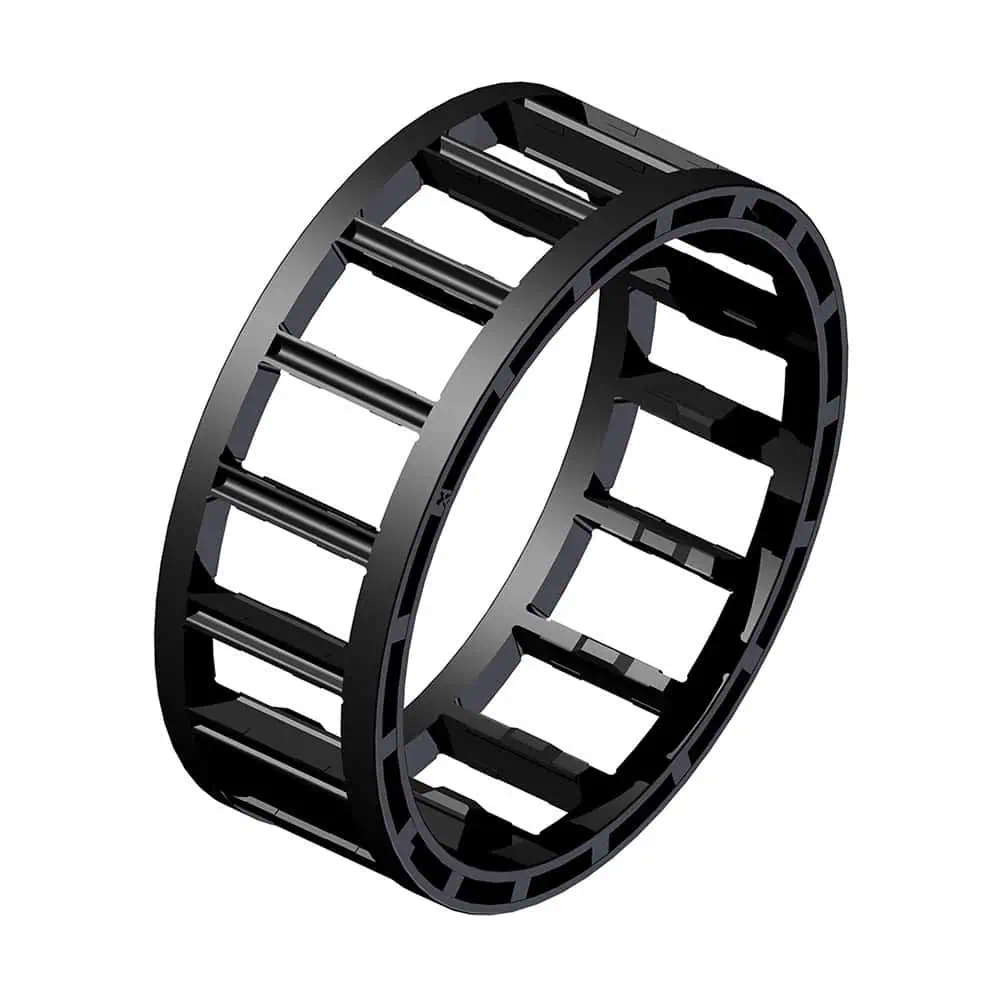
What Are Bearing Cages?
Bearing cages, also known as separators, are important components that separate and guide rolling elements within a bearing. Their main function is to maintain uniform spacing between rolling elements, reduce friction, and ensure smooth operation under various loads and speeds. In addition, the cage prevents rolling elements from falling out during assembly and disassembly of separable bearings (such as cylindrical, needle, and tapered roller bearings).
Functions of Bearing Cages
Maintaining Rolling Element Spacing
Cages prevent contact between rolling elements, reducing friction and wear while ensuring an even load distribution.
Reducing Friction and Heat
By minimizing contact between rolling elements, cages contribute to lower operating temperatures and higher efficiency.
Guiding Rolling Element Motion
Cages ensure controlled and stable movement of rolling elements, especially at high rotational speeds.
Types of Bearing Cages
Pressed Steel Cages
Lightweight and cost-effective solutions widely used in standard industrial applications.
Solid Brass Cages
Brass cages provide higher strength and are suitable for heavy loads and elevated temperatures.
Polymer Cages
Polymer cages offer low friction, quiet operation, and good performance at high speeds.
Special Cage Designs
Special solutions are used for demanding applications such as high-speed machinery or extreme operating conditions.
Materials Used for Bearing Cages
Steel
Steel cages are durable and most commonly used in general-purpose applications.
Brass and Aluminum Alloys
Brass provides high strength and good resistance to elevated temperatures.
Polymer Materials
Modern polymers offer lightweight solutions with low friction and reduced noise.
Textile-Based / Composite Materials
High-speed bearings.
How Cage Design Influences Bearing Performance
High-Speed Capability
Lightweight materials enable higher speeds and reduce centrifugal forces.
Load Distribution
Proper cage geometry ensures uniform load distribution among rolling elements.
Noise and Vibration
Cage material and design significantly affect noise levels and vibration behavior.
Most Common Cage Failures and Their Causes
Wear and Material Fatigue
Long-term loading can lead to material degradation and eventual failure.
Lubrication Issues
Insufficient lubrication increases friction and accelerates cage wear.
Contamination
Foreign particles can damage cage surfaces and disrupt proper bearing operation.
How to Select the Right Bearing Cage
Application Requirements
There are no exact mathematical criteria for selecting cage type based on operating conditions. Selection is mainly based on practical experience for a given application. The cage design can sometimes also act as a simple labyrinth seal. Key factors include speed, load, temperature, and operating conditions.
Material Compatibility
The cage material must be compatible with the lubricant and operating conditions.
Operating Environment
Harsh environments require special materials resistant to corrosion and wear.
Conclusion
Bearing cages play a key role in ensuring smooth operation, reducing friction, and extending bearing service life. Proper selection of cage type and material significantly affects performance and reliability in industrial applications. They also contribute to improved load distribution, reduced vibration, and stable operation under varying speed and temperature conditions. In many cases, correct cage design helps prevent premature failures and supports overall system efficiency and long-term operational safety in demanding environments. KINEX BEARINGS designs bearing cages to meet the highest requirements for precision and durability. If you have any questions or need technical support, please do not hesitate to contact us for further assistance.
Frequently Asked Questions
What is the function of a bearing cage?
A cage separates rolling elements, reduces friction, and ensures smooth bearing operation.
What materials are bearing cages made of?
Common materials include steel, brass, polymers, textile-based composites, and aluminum alloys depending on application conditions.
How does a cage affect bearing performance?
It influences speed capability, load distribution, noise, vibration, and overall bearing lifespan.
What causes bearing cage damage?
Wear, insufficient lubrication, contamination, excessive loads, and improper installation.
How do you choose the right bearing cage?
You must consider speed, load, temperature, and especially the operating environment.